The Cardboard Shelf
← Guides

Puzzle Boards, Tables & Mats for Puzzles in Progress

Rigid board, roll-up mat, or a dedicated puzzle table — how to store a puzzle in progress and clear the dining table without losing your place.

The real problem: you need the table back

A 1000-piece puzzle takes days to finish, but the dining table is needed for dinner tonight. Every in-progress puzzle product exists to solve that one problem: a surface you can build on, then move or cover intact and come back to later. There are three main approaches, and they line up neatly from cheapest and most portable to the deep end.

Tektalk Jigsaw Puzzle Table with Integrated Adjustable Stand/Bracket and Removable Cover, 3-Tilting-Angle Wooden Plateau Portable Puzzle Board with 4 Sorting Drawers, for Up to 1000 Pieces
Portable Wooden Puzzle Board with Cover and Drawers
A rigid wooden work surface with sorting drawers and a removable cover, so an unfinished puzzle can move off the dining table in one lift.
View on Amazon →
Affiliate link — as an Amazon Associate we earn from qualifying purchases, at no extra cost to you.

The three approaches

In-progress storage comes down to three formats, each a different balance of cost, space, and how seriously you puzzle.

  • A rigid puzzle board — a firm surface, often with a cover or drawers, that you carry or slide aside with the puzzle still on it.
  • A roll-up mat — a felt sheet you roll around a tube, storing the whole build in a slim cylinder under a bed or in a closet.
  • A dedicated puzzle table — a standalone table with legs, a cover, and sometimes wheels or sorting drawers; the committed-hobbyist option.

Rigid boards: the one-lift clear

A puzzle board is a firm, flat surface — often felt-topped — that you build directly on. The better ones add a lid that covers the puzzle to keep dust and cats off, or shallow drawers around the edge that pull out to sort pieces. The appeal is the one-lift clear: you carry or slide the whole board, puzzle intact, off the table and stash it against a wall or under a bed. Some boards are even designed to store vertically without pieces sliding, thanks to a raised lip or a cover that clamps down — genuinely handy in a small home. They're compact, affordable, and the most popular middle ground.
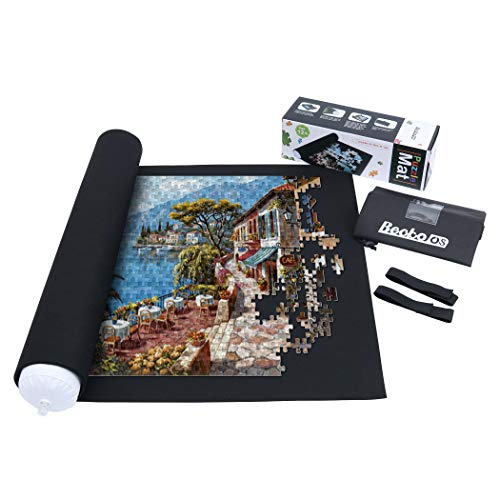
Becko US 1500 Piece Jigsaw Puzzle Mat Roll Up with Drawstring Storage Bag
Roll-Up Puzzle Mat (felt, with inflatable tube)
Build on the felt mat, then roll the whole puzzle around the inflatable tube to clear the table without losing your progress.
View on Amazon →
Affiliate link — as an Amazon Associate we earn from qualifying purchases, at no extra cost to you.

Roll-up mats: cheapest and most compact

A roll-up mat is a felt or fabric sheet you assemble the puzzle on, then roll around an inflatable tube that holds the pieces in place as it rolls. Rolled up, it stores in a slim cylinder that slides under a bed — the most space-efficient option by far, and usually the cheapest. The honest trade-off is that pieces can shift as you roll, especially over a loosely-assembled section, so a mat suits patient rolling more than a quick grab-and-go. It's the best pick when storage space is tight and you don't mind rolling carefully.

Dedicated puzzle tables: the deep end

A purpose-built puzzle table is a standalone surface with legs, usually a cover to protect the work in progress, and often sorting drawers or trays built into the frame — some on wheels so you can roll the whole thing into a corner. This is the committed-puzzler option: it costs the most and takes up permanent space, but it means never clearing a puzzle off the dining table again. Worth it if you always have a puzzle going; overkill if you build a couple a year.

Becko US 8 Puzzle Sorting Trays with Clear Lid, Puzzle Sorters for Storage
Stackable Puzzle Sorting Trays (set of 8, with lid)
Eight stacking trays with a clear lid that keep pieces sorted by color or edge while you work, then nest into a tidy tower between sessions.
View on Amazon →
Affiliate link — as an Amazon Associate we earn from qualifying purchases, at no extra cost to you.

Sorting trays: the universal add-on

Whichever surface you choose, sorting trays are the accessory that works with all three. Shallow stackable trays hold edge pieces and color groups so the build area stays clear and you're not hunting through one big pile. They pair with a board or table, stack beside a mat, and store flat when you're done. For most people, a surface plus a set of sorting trays is the whole in-progress kit.

Frequently asked questions

What is a puzzle board with a cover for?

It's a firm surface you build a puzzle on, with a lid that covers the work in progress to keep off dust and pets. The cover also lets you stack or store the board with the puzzle intact, so you can clear the table and come back to the build later without losing your place.

Puzzle board or roll-up mat — which is better?

A rigid board is sturdier and easier to move in one lift, and some store vertically without pieces sliding; it's the popular middle ground. A roll-up mat is cheaper and packs into a slim tube under a bed, but pieces can shift as you roll it. Choose a board for stability, a mat for the most compact storage.

Do I need a special puzzle table?

Only if you always have a puzzle going and want to stop clearing the dining table. A dedicated table with a cover and sorting drawers is the committed-hobbyist option — it costs the most and takes permanent space. For occasional puzzlers, a portable board or a roll-up mat does the same job for far less.

How do I keep puzzle pieces sorted while building?

Use shallow sorting trays to separate edge pieces and color groups so the build area stays clear and you're not digging through one pile. Stackable trays work alongside any surface — a board, a mat, or a table — and store flat when you're done. They're the universal add-on for a build in progress.

Shop the category
Puzzle Storage

Folders, boards, roll-up mats, and sorting trays that keep finished and in-progress jigsaw puzzles together — without the flimsy boxes taking over the shelf.

Browse picks →
Read next