Match the storage to what the puzzle is doing
'How do I store puzzles' is really four questions wearing one coat: a finished puzzle you want to keep, a puzzle you're in the middle of building, the growing stack of puzzles you're not working on, and the ones you're putting away for years. Each wants a different answer, and mixing them up is exactly why closets fill with flimsy boxes. Here's how to handle each without losing a piece — or the box art.

Finished puzzles: flat or upright?
This is the debate every puzzler eventually has, and the honest answer hinges on one thing — whether the pieces are loose or fixed. If you haven't glued the puzzle, storing it flat in its box is the safest option, because loose pieces can't slide hard against one wall the way they do standing on edge. If you want to store finished puzzles upright to save shelf space, secure the pieces first: glue and mount the puzzle, or break it into sections and bag them. Upright storage of a loose, unglued puzzle is the one setup that reliably scrambles it.
Puzzles in progress: boards and mats
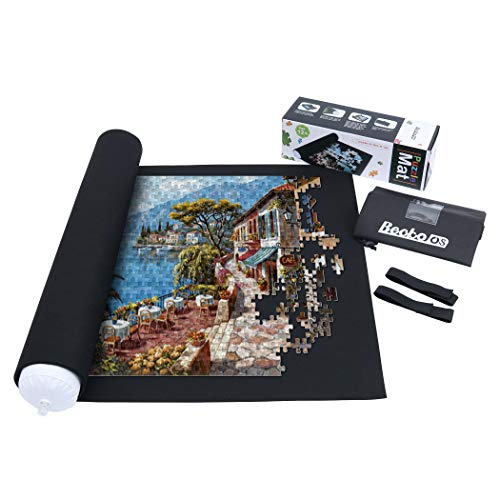
The classic problem is needing the dining table back before the puzzle's done. The fix is a portable surface you can lift away intact — a rigid puzzle board with a cover or drawers, or a roll-up felt mat with a tube that stows the whole thing under a bed. Both let you clear a work-in-progress in one move and pick it up later. Which one suits you comes down to space and how often you build; the trade-offs are worth a closer look, and we cover them in our guide to puzzle boards, tables, and mats.
Storing puzzles without the box
Original puzzle boxes are the real space hog — flimsy, awkward to stack, and mostly air. The most popular space-saver is to ditch them: move each puzzle's pieces into a zipper pouch or bag, cut the picture off the box lid, and slip it in with the pieces so you still have the image to build from. It can shrink a shelf of boxes to a fraction of the space. The honest caveat: some collectors like keeping their boxes intact, and the box matters if you plan to resell or trade, so bag only the puzzles you're sure about.
Kids' puzzles need to be seen
Chunky wooden and 100-piece kids' puzzles follow one extra rule: children use what they can see. Store each puzzle's pieces in a clear pouch or a labeled zipper bag so a child can spot the one they want and actually put it back — an opaque bin at the back of a closet just doesn't get used. Clear pouches also keep each small piece count together, so you notice a missing piece before it's lost for good.
Long-term storage: mind the climate
Puzzle pieces are cardboard, so they warp, swell, and curl in exactly the conditions that ruin board games. For puzzles you're storing for months or years, keep them somewhere cool, dry, and stable — an interior closet, not an attic that bakes or a basement that gets damp. Seal them in bags or bins so humidity can't creep in, keep them off the floor, and don't crush the bottom of a deep stack. Treated that way, a puzzle comes out years later ready to build again.