The number on the pack is per face
This is the single most useful thing to know about sleeve thickness, and it is almost never spelled out. A sleeve is rated in microns, and that figure describes the film itself, not the sleeve as a whole. Your card sits between two layers of that film. So a sleeve sold as 100 micron adds 200 microns to every card, not 100. Ultra PRO make this unambiguous in their own specification, which lists their premium lines as 90 micron clear front and 120 micron back — a description that only makes sense per face.

What that does to a real deck
A standard board game card is around 0.31 mm. Put it in a 100 micron sleeve and it becomes 0.51 mm, which is a 65% increase. That is not a rounding error, it is most of the card again. For a game with a couple of hundred cards, sleeving in thick sleeves adds several centimetres of stack height, and the original insert was moulded around the unsleeved number.

Work out your own game
The general rule only gets you so far, because card counts and card stock both vary. The sleeved deck thickness calculator will do it for a specific game — it already knows the card counts for every game with a sleeve guide on this site — and will tell you whether the result still clears a slot depth you enter. It also handles double-sleeving, which people tend to underestimate most of all.

Measure your cards rather than trusting a figure
Card stock genuinely varies between publishers, print runs and finishes, and sources disagree by enough to matter once you multiply it by three hundred. The reliable move takes a minute: square off a known number of unsleeved cards, measure the stack with calipers or against a ruler, and divide. Fifty cards is a good sample. That single measurement beats any preset, and the calculator takes it as an override.
Height is not the only dimension that bites
Most of the attention goes to stack height because that is what stops a lid closing, but a sleeve also makes each card slightly wider and noticeably taller — typically a couple of millimetres of lip above the card. A moulded insert with snug card wells can reject a sleeved deck on those axes while the lid would have closed fine. If your insert has tight card slots rather than open trays, check the footprint as well as the stack.

The four honest options when it does not fit
There is no clever trick here, only trade-offs, and it is worth being straight about what each one costs you.
- Thinner sleeves. The cheapest fix and usually the right one for card-heavy games. Going from a 100 micron sleeve to a 60 cuts the added height by 40%, and for cards that get shuffled rarely the protection difference is small.
- Move the cards out. A card box holds the deck outside the game box entirely. This is standard practice for card-driven games and campaign games, and it usually improves setup as well.
- Replace the insert. A shallower or better-packed insert can free up real depth, and a foamcore build can be cut to the sleeved dimensions rather than the factory ones.
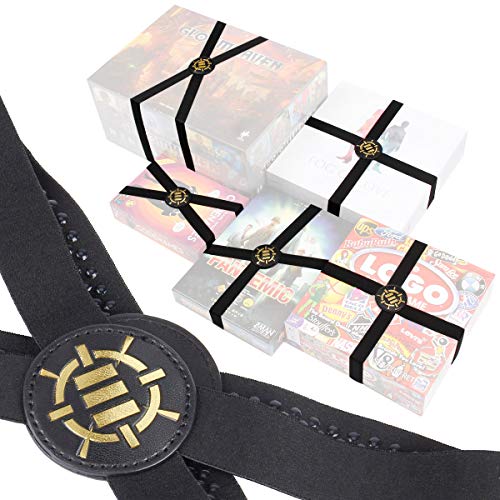
- Let the lid sit proud and band the box. Far more common than anyone admits, and a band is by a distance the cheapest answer. The cost is that the box no longer stacks cleanly and dust gets in.
Which sleeve thickness should you actually use
For most board games, a thin to mid sleeve in the 40 to 60 micron range is the sensible default: it protects against the wear that actually happens, and it costs the least box space. Thicker sleeves earn their place where cards are shuffled constantly, handled by many players, or genuinely irreplaceable — deckbuilders, card-driven wargames and anything with a collectible element. Thickness is also not the same as quality. Material, clarity, seam consistency and cut accuracy matter as much, and a well made 60 micron sleeve outperforms a badly made 100.
Double-sleeving, and what it really costs
Double-sleeving puts the card in a thin inner sleeve and then into an outer one, usually with the inner sealed the opposite way round so the card is fully enclosed. It is genuinely the best protection available. It is also the most expensive in box space by a wide margin: an inner plus a 100 micron outer roughly doubles a deck’s height. Reserve it for cards that justify it, and assume from the outset that they are not going back in the original insert.
Sleeve first, then decide about storage
A practical ordering that saves regret: sleeve one deck, put it back in the box, and look at the lid before you sleeve the other five. A single deck tells you the real per-card thickness for that specific game, and it is far easier to change your mind about sleeve choice after twenty minutes than after an evening.